
The 2026 Indie Designer’s Guide to Cold Foil TCG Printing (Stop Making Your Cards Look Like Stickers)
We know the feeling. You spent 40 hours illustrating a stunning "Full Art" character for your new Trading Card Game. You sent the files to a POD (Print-on-Demand) shop, waited three weeks, and finally opened the prototype box.
BLOG
2/27/20265 min read
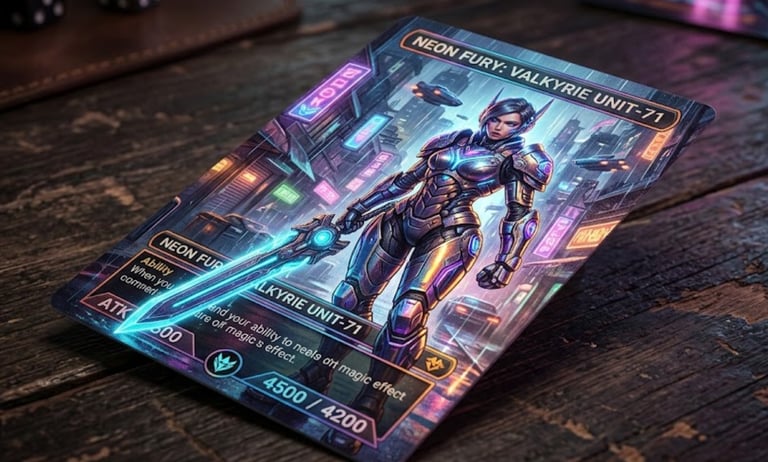
We know the feeling. You spent 40 hours illustrating a stunning "Full Art" character for your new Trading Card Game. You sent the files to a POD (Print-on-Demand) shop, waited three weeks, and finally opened the prototype box.
Your heart sinks.
Instead of glowing, metallic armor and shimmering magical effects, the printer just slapped a thick, mirror-like foil over your illustration. Your delicate linework is hidden. The card feels like a cheap sticker. Alternatively, they printed it on standard holographic paper, making the entire card overwhelmingly shiny so the artwork completely washes out in the light.
If you are trying to launch a TCG in 2026, or if you are an artist selling high-end proxy cards on Patreon, your backers expect the same tactile luxury they get from opening a fresh pack of Pokémon or Flesh and Blood.
To get that, you have to stop using traditional foil methods. You need to understand Cold Foil.
Here is the insider truth about how major publishers print their ultra-rare cards, and how you can do exactly the same thing.
🔍 Quick Answer
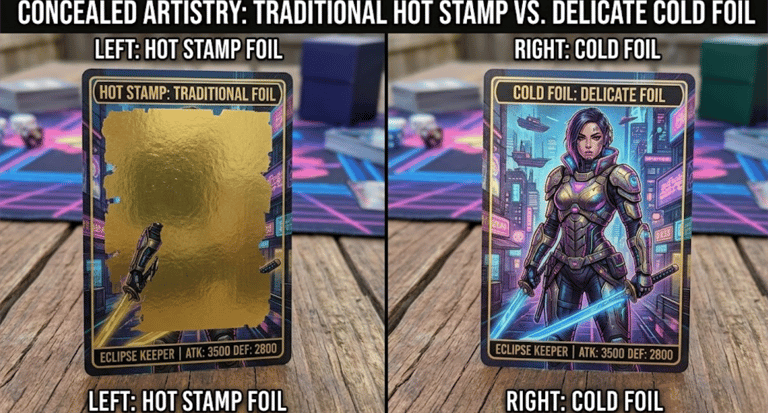
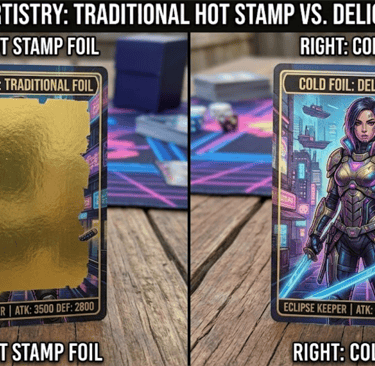
What is Cold Foil Printing for custom TCGs? Cold Foil is a premium printing technique where a metallic silver layer is applied to the paper before the CMYK ink. Unlike traditional Hot Stamping (which is opaque and covers the artwork), Cold Foil allows translucent ink to be printed directly on top of the silver foil. This creates seamless holographic gradients, vibrant metallic colors, and complex "Full Art" textures without obscuring the artist's original drawing.
The "Cheap Foil" Trap: Hot Stamping vs. Holographic Paper
To understand why your last batch of cards looked wrong, you need to know what the cheap factories are actually selling you.
The Hot Stamp Trap: Hot stamping is like pressing a metallic branding iron onto your card. It is 100% opaque. It sits on top of your ink. If you want a solid gold border or a shiny logo, hot stamping is great. But if you want a character's eyes to glow subtly, or a sword to reflect light, hot stamping will just cover those details with a solid block of foil.
The "Holo Paper" Trap: Many low-MOQ printers just print your art directly onto rainbow holographic paper. The problem? Without proper opaque white ink masking, the entire card becomes a chaotic, blinding rainbow. There is no contrast. The deep shadows of your painting disappear into the glare.
The Cold Foil Magic: Printing Over the Shine
Cold Foil changes the entire physics of the card. Think of it as a three-layer sandwich:
📄 Layer 1 (The Base): Premium Card Stock.
✨ Layer 2 (The Middle): The Cold Foil silver layer (applied exactly where you want it).
🎨 Layer 3 (The Top): Your standard CMYK printing ink.
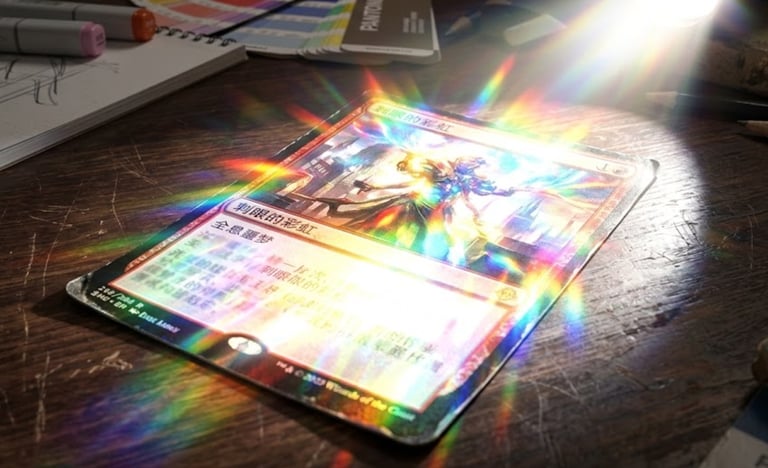
Here is the secret: Standard CMYK printing ink is actually translucent. When we print yellow ink over the silver Cold Foil, it becomes a brilliant, reflective Gold. When we print cyan over it, it becomes metallic Sapphire.
This means you can have a character standing in a dark, matte forest (no foil), holding a sword that catches the light with a perfect metallic gradient. You get infinite metallic colors without paying for different colored foils. The foil becomes a part of the painting, rather than a sticker sitting on top of it.
The Designer’s Blueprint: Setting Up Your Foil File
(💡 Pro Tip: Save this section for your pre-press checklist!)
Most artists don't use Cold Foil because they think it's too technical. It’s actually incredibly simple once you know the rule of the "Mask." If you want to print with VNK, here is how you prepare your file:
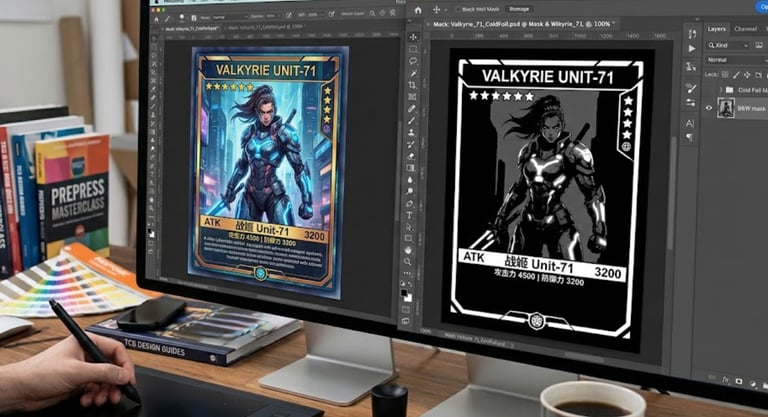
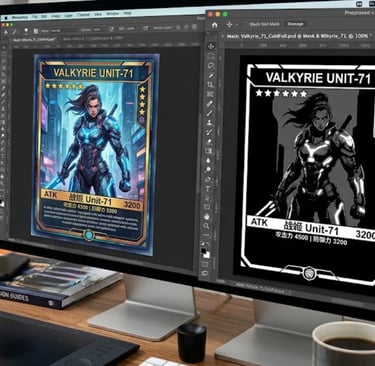
The K=100 Mask Layer: You will create a separate layer in Photoshop or Illustrator. Everywhere you want the card to be metallic, you color it 100% Black (K=100). Everywhere you want normal, non-shiny paper, you leave it white.
Greyscale is Your Friend: You don't have to go 100% shiny. Want a subtle, soft shimmer on a water spell? Set your mask brush to 40% greyscale (or 40% opacity). The printing press converts this into a halftone screen, giving a delicate gleam rather than a blinding flash.
Keep Vectors Sharp: For UI elements, borders, and text, always keep them as vector files in your PDF. This ensures the edges of your foil are razor-sharp.
The Foundation: Why Cold Foil Demands "German Black Core"
You cannot build a luxury house on a swamp. Cold Foil requires a flawlessly smooth, dense surface to adhere properly. If you use cheap, porous paper, the foil will look pitted and rough.
This is why, at VNK, we pair our Cold Foil printing exclusively with 310gsm German Black Core paper.
If you are designing a TCG, you already know about the "Flashlight Test." German Black Core has a graphite layer fused into the center of the paper. It is 100% opaque. Players cannot shine a phone light through the back to see what card is coming next. It provides the legendary "snap" when shuffled, and it provides the absolute perfect canvas for Cold Foil to lay flat like glass.
Breaking the Monopoly: Accessing the Heidelberg Presses
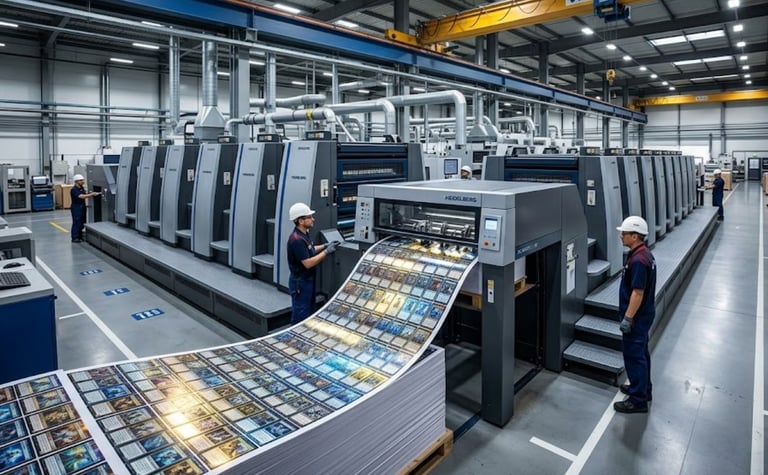
Historically, Cold Foil was locked behind massive corporate paywalls. Because it requires massive inline printing presses (like the Heidelberg Offset machines we use at VNK), factories usually demand a Minimum Order Quantity (MOQ) of 10,000 to 50,000 decks.
This left indie designers stuck with the "Cheap Foil" traps.
We changed the math. By optimizing our pre-press workflow, VNK has lowered the barrier for authentic Cold Foil TCG printing to an MOQ of just 500 decks.
500 decks is the exact threshold where an indie project transforms from a "prototype" into a retail-ready, highly profitable product. You get the exact same manufacturing technology used by the biggest games in the world, at a volume that makes sense for a Kickstarter launch or a Patreon drop.
Conclusion: Don't Guess. Let Our Engineers Look at Your Art.
Figuring out foil masks for the first time can be intimidating. You shouldn't have to guess if your shadows are too dark or if your highlights will shine correctly.
Stop fighting with your files.
👉 [Get a Free File Review] Send us one of your custom TCG character designs. Our pre-press engineering team will look at your art, tell you exactly how Cold Foil would react to your colors, and give you a custom quote for a 500-deck run. No commitment, just honest advice from people who love printing great games.
Add: Dongci Industrial estate, Shijie Town, Dongguan City, Guangdong Province, China 52300
Copyright 2025 © Dongguan VNK Playing Card Co., Ltd. All Rights Reserved.
CONTACT US
Email: info@vnkplayingcard.com
PRODUCTS
QUICK LINKS