
The Math Behind a $75 Kickstarter Tarot Deck: Cold Foil, Black Core, and Your Actual Margins
How can indie creators protect their profit margins when unlocking luxury tarot stretch goals on Kickstarter?
BLOG
6/3/20265 min read
How can indie creators protect their profit margins when unlocking luxury tarot stretch goals on Kickstarter?
The secret isn't selling more decks; it's optimizing how they are made. To successfully clear a $65 - $85 retail tier without drowning in production costs, creators must leverage a single-facility manufacturer capable of executing K=100 cold foil masking and sourcing 330gsm German Black Core paper at a tight 500 MOQ. Consolidating the cards, guidebooks, and custom rigid boxes under one roof eliminates cross-factory dimensional errors and slashes per-unit costs, converting high-end stretch goals into pure net profit.
The $75 Illusion: Why Most High-End Crowdfunding Campaigns Lose Money
May 2026 data from Kickstarter reveals a massive shift in the tarot and oracle market: 87% of campaigns that raised over $50,000 utilized premium stretch goals to drive backer engagement.
By unlocking features like shimmering cold foil faces and heavy-duty magnetic boxes, these indie creators successfully pushed their early-bird tiers into the $65 to $85 premium price bracket. To a digital illustrator, selling a deck for $75 sounds like an absolute goldmine.
Then the campaign ends, the invoice from the printing factory arrives, and reality sets in.
Many creators realize too late that they calculated their margins based on "flat" digital printing, completely ignoring the industrial setup costs of heavy offset machinery. When you try to fragment your supply chain—sourcing cards from one print shop, rigid boxes from another, and a third-party warehouse for assembly—your profit margins don't just shrink; they vanish.
As production engineers who run a high-end card manufacturing ecosystem, we don’t look at tarot decks as mystical art; we look at them as a balance sheet of machine setup times, paper weight tolerances, and shipping volume. Let’s look at the actual math behind a profitable $75 deck and see where the money usually goes.
The Industrial Math: Break-Even vs. Out-of-Pocket
The biggest trap in premium manufacturing is machine economics. You cannot achieve museum-grade, shimmering metallic artwork on a digital press. It requires commercial offset equipment, such as our multi-color Heidelberg presses.
Setting up an offset press requires making physical aluminum plates, mixing custom inks, and running test sheets to lock in registration. The setup cost is fixed whether you print 100 decks or 10,000 decks.
Digital Print Shop (Low MOQ): High Per-Unit Cost ($25-$35) ➔ Ruined Profit Margins
Traditional Factory (High MOQ): Massive Upfront Risk (5,000 Decks) ➔ Dead Cash Flow
VNK Precision Cell (500 MOQ): Optimized Offset Cost ($8-$12) ➔ The Golden Margin Sweet Spot
If you print 100 decks via digital hot-stamping, your per-unit cost can skyrocket to $35, leaving you with zero breathing room after Kickstarter fees, platform taxes, and fulfillment logistics.
However, hitting a 500 MOQ (Minimum Order Quantity) on a highly calibrated offset line completely changes the financial model. It distributes the fixed machine setup fees across enough units to drop your production costs drastically into a highly lucrative zone.
The Blueprint: Sourcing a 500 MOQ Premium Tier Box Set
Let’s look at the production breakdown for a standard luxury setup: 78 cards, a 100-page hardcover guidebook, a custom lid-and-base rigid box, and full assembly (kitting).
1. The Cards: 330gsm German Black Core + K=100 Cold Foil
Premium backers expect a physical presence. Standard 300gsm coreless paper feels flimsy and translucent under bright light. Upgrading to 330gsm German Black Core provides a rigid graphite center layer that prevents light bleed and delivers an aggressive, professional "snap."
Instead of traditional hot-stamping (which crushes details under a solid metallic plate), we utilize K=100 Cold Foil Masking. We print your rich CMYK colors directly over a metallic foundation layer at a 0.1mm tolerance. This creates a multi-dimensional, translucent metallic glow that preserves every line of your original ink work.
2. The Container: Soft-Touch Rigid Boxes
A premium deck requires premium protection. We manufacture 1200gsm greyboard boxes wrapped in anti-scratch Soft-Touch Lamination.
Because our structural engineers calculate the exact micro-dimensions of your 330gsm cards and guidebook under the same roof, the box is built to a 0.3mm cutting tolerance. No rattling, no sliding, no damaged corners during ocean shipping. When your backer opens the box, they experience a smooth, vacuum-sealed resistance.
The Spreadsheet: Standard vs. VNK All-in-One Margin Model
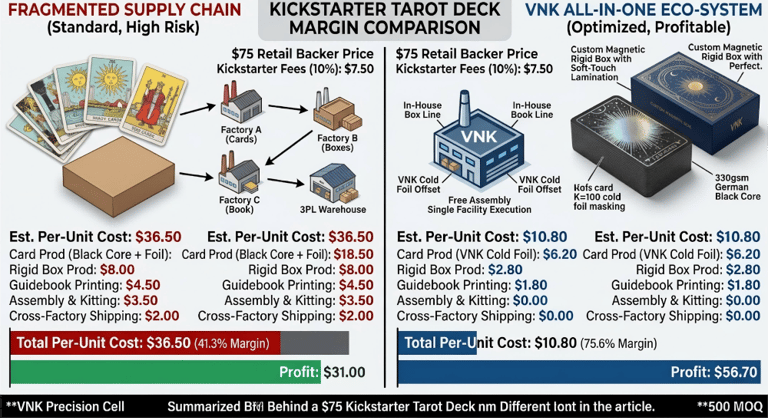
The math doesn't lie: Consolidating production increases your net margin by over 80%. Assuming a successful Kickstarter campaign selling a premium deck at $75 USD with a 500-unit production run:
By consolidating your production into a single facility, your net profit per deck jumps from a risky 41.3% to a highly resilient 75.6%. That extra $25.70 per deck is what allows you to reinvest in your next art series, purchase advertising, or fund your living expenses as a full-time creator.
Stop Calculating. Start Engineering.
Your backers are investing in your creative vision, but your business relies on manufacturing reality. Don’t let misaligned files, fluctuating vendor fees, or dimensional errors compromise your launch.
We protect indie creators by acting as an extension of their studio. We manage the ink viscosities, the foil masking tolerances, and the freight clearances so you can focus entirely on your community.
👉 [Submit Your Draft Design for a Free Margin Optimization Review]
(Are you currently building your Kickstarter or Gamefound preview page? Send our engineering team 1 or 2 of your master files. We will review your line work, show you how to structure your K=100 foil masks, and provide a comprehensive, all-inclusive quote for a 500-deck run—covering everything from the German black core to the soft-touch boxes. Let’s make your premium launch legally, artistically, and financially bulletproof.)
💡 (FAQ) for Kickstarter Creators
Q: How much does it actually cost to manufacture a premium tarot deck?
A: It heavily depends on your supply chain structure and Minimum Order Quantity (MOQ). If you use a fragmented supply chain (printing cards at one shop, making boxes at another) for a 500-unit run, your per-unit cost can skyrocket to $30–$35 due to multiple machine setup fees. However, by utilizing a single-facility offset manufacturer like VNK at a 500 MOQ, the cost for a premium deck (including black core paper, cold foil, and rigid boxes) drops to an optimized $10–$12 per unit.
Q: How to calculate profit margins for a Kickstarter tarot campaign?
A: To calculate your true margin, you must subtract your Total Landed Cost (manufacturing + kitting + cross-factory shipping + freight) and Platform Fees (Kickstarter + payment processing, usually ~10%) from your Retail Tier Price. For a luxury deck priced at $75, an all-in-one manufacturing process can secure a ~75% net margin, whereas a piecemeal supply chain often shrinks that margin to below 40%.
Q: Why do Kickstarter creators lose money on stretch goals?
A: This is known as "Stretch Goal Bankruptcy." It happens when creators promise luxury upgrades (like metallic edges, foil, or heavy-duty rigid boxes) but source them from different vendors. The compounding costs of separate machine setup fees, in-land shipping between factories, and third-party warehouse kitting labor quickly consume the extra funds raised during the campaign. Consolidation is the only way to protect your stretch goal profits.
Q: What is the difference between cold foil and hot stamping for complex vector art?
A: Hot stamping uses a heated die to press a solid, opaque metal sticker onto the paper. It often bleeds over edges and completely covers the artwork underneath. K=100 Cold Foil Masking is a high-end offset process. We lay down a metallic base layer first, then print your CMYK colors over it. This achieves a 0.1mm registration accuracy, allowing intricate details like glowing neon or watercolor gradients to shine with a translucent metallic effect without losing any vector detail.
Q: How to prevent custom rigid boxes from rattling during shipping?
A: Rattling and edge damage occur when cards and boxes are manufactured in different facilities with mismatched dimensional tolerances. To prevent this, you must use an all-in-one kitting facility. Structural engineers must calculate the rigid box die-lines based on the exact micro-thickness of your specifically chosen cardstock and guidebook, aiming for a cutting tolerance of ≤ 0.3mm. This ensures a perfect, vacuum-sealed fit.
Q: What is the best cardstock for tarot cards? Is German Black Core worth it?
A: For premium crowdfunding tiers ($65+), standard 300gsm art paper is unacceptable; it feels flimsy and allows light to bleed through the cards. 330gsm German Black Core is the industry standard for luxury decks. It features an internal graphite layer that blocks 100% of light and provides an aggressive, professional "casino snap" for perfect shuffling. If you are positioning your deck as a high-end tool, German Black Core is absolutely worth the investment.
Add: Dongci Industrial estate, Shijie Town, Dongguan City, Guangdong Province, China 52300
Copyright 2025 © Dongguan VNK Playing Card Co., Ltd. All Rights Reserved.
CONTACT US
Email: info@vnkplayingcard.com
PRODUCTS
QUICK LINKS