
The 2026 Guide to Custom TCG Printing: Mastering Cold Foil, Holographics, and "Full Art" Styles
If the last 30 days of data from Kickstarter, Patreon, and the secondary market tell us anything, it’s that TCG players have evolved. Fueled by recent design shifts in major franchises—like the "Wasteland" aesthetics of the Magic: The Gathering x Fallout crossover or the textured luxury of the latest Pokémon "Mega" returns—players now judge a card by its finish just as much as its mechanics.
BLOG
2/4/20264 min read
Welcome to 2026. The era of flat, glossy cards is officially over.
If the last 30 days of data from Kickstarter, Patreon, and the secondary market tell us anything, it’s that TCG players have evolved. Fueled by recent design shifts in major franchises—like the "Wasteland" aesthetics of the Magic: The Gathering x Fallout crossover or the textured luxury of the latest Pokémon "Mega" returns—players now judge a card by its finish just as much as its mechanics.
For indie creators and "Alternative Art" designers, this raises the bar. To compete, your custom cards need to look and feel like they were pulled from a fresh booster pack.
Here is your technical roadmap to replicating the hottest TCG trends of early 2026, and exactly how we manufacture them at VNK.
📋 The Creator’s Cheat Sheet
Quick answers for busy designers:
Q: How do you print professional TCG cards in 2026? To match the quality of major publishers, follow these manufacturing standards:
For "Full Art" Foils: Use Cold Foil (not Hot Stamp). It allows the metallic shine to sit under the ink, creating gradients and glowing effects within the illustration.
For "Wasteland/Retro" Style: Combine a Matte Finish with Spot UV (gloss) to highlight specific UI elements like text boxes or energy bars.
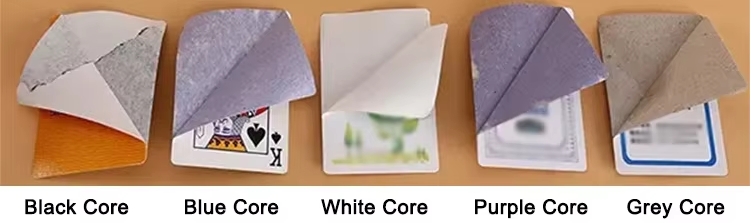
Paper Stock: Always use 310gsm German Black Core. It passes the "Flashlight Test" and provides the correct "snap" when shuffling.
Trend 1: The "Wasteland" Aesthetic (Grimy & Industrial)
The Vibe: Inspired by the massive success of post-apocalyptic crossovers, designers are moving away from clean vector art. The trend is rust, gears, old computer terminals, and grit.
❌ The Design Problem: If you print a "rusty" design on standard glossy paper, it looks fake. It looks like a photo of rust, not actual rust.
✅ The Printing Solution: Matte Varnish + Spot UV At VNK, we recommend a deep Matte Finish for the card surface. This absorbs light, giving the card a "worn" texture. Then, we apply Spot UV (High Gloss) only on specific areas—like a glowing green radar screen, a laser beam, or the card name.
The Result: When the player tilts the card, the "screen" glows while the "metal" stays matte. It creates a physical depth that flat printing cannot achieve.
Trend 2: The "Mecha" & Brushed Metal Look
The Vibe: With the rise of Gundam-style TCGs and sci-fi themes in 2026, designers want cards that look like they are made of steel.
✅ The Printing Solution: Silver Card Stock (The Nuclear Option) Instead of printing on white paper, we print directly onto Silver Card Stock.
The Technique (White Ink Masking): We use opaque white ink to mask the areas that shouldn't shine (like skin or cloth). Everywhere else, we leave the silver stock exposed or tint it with transparent CMYK ink.
The Result: A card that looks like a literal piece of brushed metal machinery. This is increasingly popular for "Chase Cards" (Rare cards).
Trend 3: "Storybook" Shimmer (The Lorcana Effect)
The Vibe: Influenced by the rise of "Soft Fantasy" TCGs (like Lorcana), there is a huge demand for art that feels hand-painted yet magical.
✅ The Printing Solution: Rainbow Holographic Foil Unlike the harsh, jagged "Cracked Ice" foil of the past, the 2026 trend is Rainbow Foil. It offers a smooth, buttery color shift that enhances hand-drawn or watercolor styles without overpowering the delicate linework.
🔧 The Technical Showdown: Cold Foil vs. Hot Stamp
This is the #1 concept indie designers misunderstand. If you want to print a custom "Full Art" commander or a modern TCG, you must know the difference.
1. Hot Stamp (The "Old School" Way) Think of this as a sticker. We press a heated foil stamp on top of your printed card.
Pros: Very shiny (mirror-like).
Cons: It is opaque. It covers your artwork. You cannot print gradients on it. It’s mostly used for simple logos or text.
2. Cold Foil (The "Pro" Way – VNK Specialty) This is how modern TCGs are made. We apply the foil layer first (or inline), and then print your CMYK artwork over it.
The Magic: Because printing ink is translucent, the metallic shine comes through your art. You can make a character's eyes glow metallic red, or make water shimmer blue.
Why VNK? Most factories require 10,000 decks for Cold Foil. VNK brings this technology to you starting at just 500 decks. This is the secret to making your indie project look like a million-dollar release.
🛡️ The "Flashlight Test": Why Paper Matters
Serious TCG players have a habit: they take a card and shine their phone’s flashlight through it.
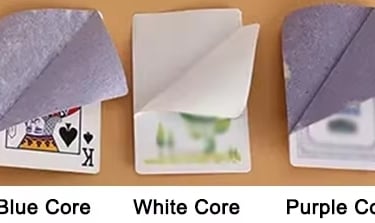
Blue Core / Grey Core: The light passes through. The card feels "papery."
German Black Core: Blockage. Darkness.
At VNK, we treat 310gsm German Black Core as our baseline standard for TCGs. It contains a graphite layer sandwiched between the paper. This ensures:
Zero Transparency: Your opponent cannot see the card back through the light (Anti-Cheating).
The "Snap": The card returns to its flat shape instantly after being bent or shuffled.
🚀 From "Alternative Art" to "Factory Run"
(A Note on Intellectual Property) We love printing custom proxies and original TCGs. However, please note that we champion original creativity. We respect copyright laws and do not print counterfeit cards with original trademark logos (e.g., the official Pokémon card back). We are here to bring your original designs and artistic interpretations to life.
The "500 Deck" Reality Check
You might be asking: "Can I just print 50 decks?"
We will be honest with you. If you print 50 decks, you are limited to Digital Printing. You lose the Cold Foil. You lose the Spot UV alignment precision. You get a prototype, not a product.
At VNK, our Minimum Order Quantity (MOQ) is 500 decks. Why? Because at 500 decks, we fire up the Heidelberg Offset Presses.
We calibrate the color profiles to ISO standards.
We apply the Cold Foil inline.
We use heavy industrial cutters for perfectly centered borders.
500 decks is the threshold where "Hobby" becomes "Professional."
Ready to Build Your Deck?
The trends of 2026 are complex, but printing them doesn't have to be. Whether you are designing a Wasteland survival game or a high-fantasy TCG, we have the foil tech to make it shine.
Stop looking at your design on a screen. Let's make it real.
👉 [Get a Custom Quote for Cold Foil Printing] (Attach your art file for a free material recommendation)

Add: Dongci Industrial estate, Shijie Town, Dongguan City, Guangdong Province, China 52300
Copyright 2025 © Dongguan VNK Playing Card Co., Ltd. All Rights Reserved.
CONTACT US
Email: info@vnkplayingcard.com
PRODUCTS
QUICK LINKS