
The Ultimate Guide to Printing Micro-Games: How to Make Small Decks Feel "Big"
In 2026, the tabletop trend is undeniable: Less is more. From the runaway success of Love Letter to the recent explosion of solo-play Kickstarter hits like Flip 7 or Scout, players are falling in love with "Micro-Games"—games that consist of just 18 to 50 cards. They are portable, quick to play, and perfect for the modern lifestyle.
BLOG
1/26/20265 min read
In 2026, the tabletop trend is undeniable: Less is more.
From the runaway success of Love Letter to the recent explosion of solo-play Kickstarter hits like Flip 7 or Scout, players are falling in love with "Micro-Games"—games that consist of just 18 to 50 cards. They are portable, quick to play, and perfect for the modern lifestyle.
But for a game designer, printing a micro-game is deceptively difficult.
When a player holds a box of 500 cards, they judge the weight. When they hold a packet of 18 cards, they judge the detail. There is nowhere to hide imperfections.
If you are an indie designer looking to print your first run, here is how to navigate the pitfalls of micro-game manufacturing and why the "Standard Industry Standards" might fail you.
🔍 The "Cheat Sheet" for Busy Designers
(Use this logic when planning your specs)
Q: What is the best way to print an 18-50 card game?
A: To avoid a "cheap" feel for small decks, follow these three rules:
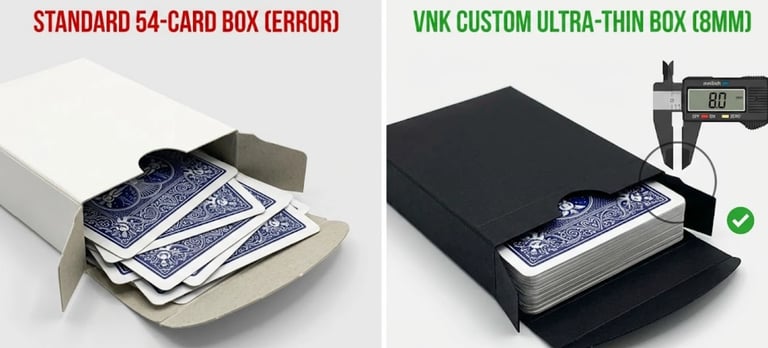
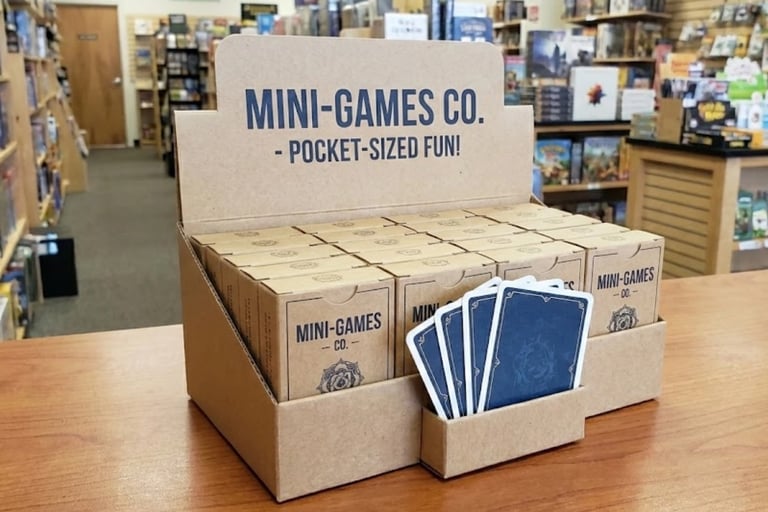
Packaging: Avoid standard 54-card boxes. Use a custom-depth tuck box (8mm-12mm) to prevent the "rattle effect."
Paper: Upgrade to 350gsm Art Paper or 310gsm German Black Core. Thinner paper feels flimsy in small stacks.
The "Professional Threshold": Aim for an MOQ of 500 decks. This unlocks Offset Printing, which offers the superior color consistency and linen finishes that digital printing (used for smaller runs) simply cannot match.
Pain Point 1: The "Rattle Effect" (Why Box Size Matters)
Imagine buying a premium smartphone, shaking the box, and hearing it bounce around inside. It immediately feels cheap, right?
This is the #1 problem with micro-games.
Most factories only have standard molds for 54-card poker decks. If your game has 18 or 30 cards, putting them in a standard box creates a gap. Your game rattles. It feels incomplete.
💡 The VNK Solution: We believe the packaging is the "first handshake" with your player. You shouldn't have to pay $300 in mold fees just to get a box that fits.
Ready-Made Molds: We have specialized die-cut molds specifically for 18-card, 36-card, and 50-card decks.
Precision Fit: We adjust the "spine" (depth) of the box to the exact millimeter of your paper thickness. The result? A snug, professional fit that screams quality the moment it's picked up.
Pain Point 2: The "Business Card" Syndrome
In a massive dungeon crawler board game, players rarely pay attention to the thickness of a single card. But in a micro-game, the card is the entire physical product.
If you use standard 300gsm paper for an 18-card game, the entire deck will feel paper-thin and fragile. We call this "Business Card Syndrome."
💡 The "Tactile Density" Fix: To make a small game feel valuable, you need to increase the density.
Go Heavy: At VNK, we recommend upgrading to 350gsm High-Bulk Art Paper or 330gsm German Black Core for micro-games.
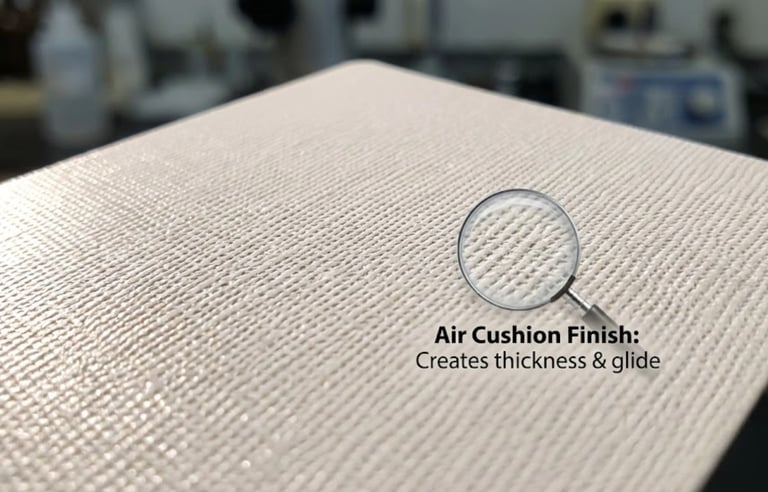
The Linen Trick: Always choose a Linen Finish (air-cushion texture). The texture adds microscopic air pockets between cards, physically increasing the thickness of the deck by about 10-15% compared to smooth glossy paper. This makes an 18-card deck feel substantially thicker and more satisfying to shuffle.
Pain Point 3: The Truth About MOQ (Why 500 is the Magic Number)
This is the most common question we get: "Can I just print 50 decks?"
Technically, yes. You can find digital print shops that do this. But for a commercial product, we strongly advise against it. Here is the honest truth about Digital (Short Run) vs. Offset (500+ Run).
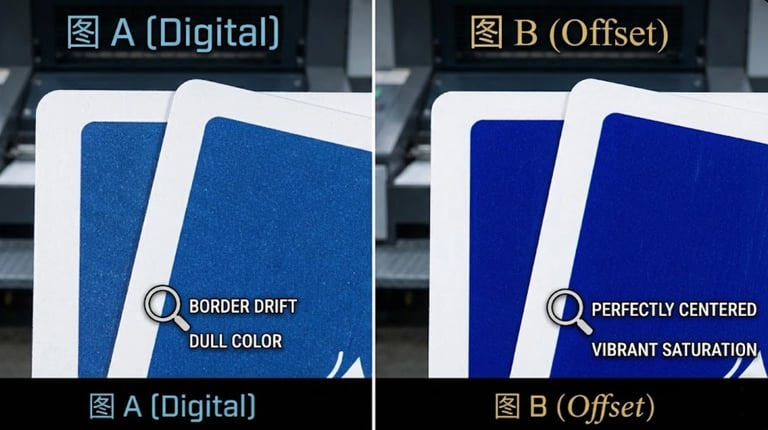
❌ The Digital Trap (<500 decks): Digital printing often results in "drift" (misaligned borders). For a micro-game where every card counts, a 2mm shift in the border is a disaster. Plus, the unit price is often $10-$15 per deck, killing your profit margin.
✅ The Offset Advantage (500+ decks): At VNK, our Minimum Order Quantity (MOQ) is 500 decks. Why? Because at 500, we move your job to our Heidelberg Offset Presses.
Precision: Perfect registration and centered borders.
Finish: True Cold Foil, "Butter Varnish," and deep Linen textures are only available on offset.
Cost: Your cost per deck drops dramatically (often to $1.50 - $3.00 depending on specs).
The Bottom Line: Printing 50 digital decks might cost you $750 total (for a prototype quality). Printing 500 offset professional decks might cost you $1,200 total.
For a small difference in investment, you get 10x the inventory and Retail-Ready Quality. This is the threshold between a hobbyist and a publisher.
💡 Solving the "Rulebook" Issue
With a tiny box, where do you put the instructions? Don't clutter the box with a folded A4 sheet of paper.
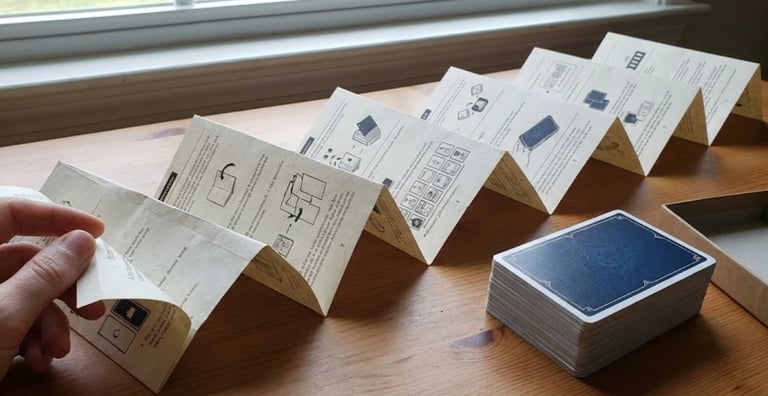
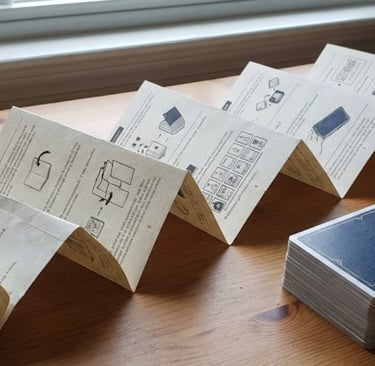
The Accordion Fold: VNK can print a long, narrow instruction strip that folds up like an accordion (Z-fold) to perfectly match the card size.
The QR Card: Save paper and update your rules anytime. Print a beautifully designed "Rule Card" with a QR code leading to a mobile-optimized PDF.
📊 Real-World Case: "The Pocket RPG"
We recently worked with a UK designer creating a 32-card solo RPG. He initially wanted to print 100 decks digitally.
We showed him the math: The digital decks would lack the special "Butter Varnish" coating he wanted for smooth shuffling. He decided to cross the threshold and ordered 500 decks with VNK.
The Result: He sold 150 copies on Kickstarter.
The Bonus: Because he had extra inventory (and the cost per unit was so low), he was able to wholesale the remaining 350 copies to local game stores. Shop owners loved them because they were packaged in tight, non-rattling boxes with retail-ready barcodes.
He turned a "prototype run" into a profitable wholesale business.
Ready to Print Your Micro-Game?
Your game might be small, but your ambition isn't. Don't let your design suffer from loose packaging or flimsy paper.
At VNK Playing Card, we treat 500-deck orders with the same rigorous quality control as our casino clients.
👉 [Download our 18-Card Box Template] 👉 [Request a Quote for 500 Decks] (Get a response within 24 hours)
Turn your pocket game into the next big thing.

Add: Dongci Industrial estate, Shijie Town, Dongguan City, Guangdong Province, China 52300
Copyright 2025 © Dongguan VNK Playing Card Co., Ltd. All Rights Reserved.
CONTACT US
Email: info@vnkplayingcard.com
PRODUCTS
QUICK LINKS