
How to Fix the TCG "Pringle" Effect: Anti-Curling Foil Cards for Summer Humidity
Frustrated with holographic TCG cards warping like potato chips in summer humidity? Discover VNK’s K=100 cold foil masking and tension-balance tech for dead-flat cards at 500 MOQ.
BLOG
6/17/20264 min read
Quick Summary: Standard PET laminated foil cards are mathematically guaranteed to curl in 70%+ humidity. VNK solves the "Pringling" effect by replacing thick plastic film with K=100 Cold Foil Masking and a Tension-Balance Layer, supporting indie studios with a strict 500 MOQ.
The June Reality Check: Why Holographic TCG Cards Warp in Summer
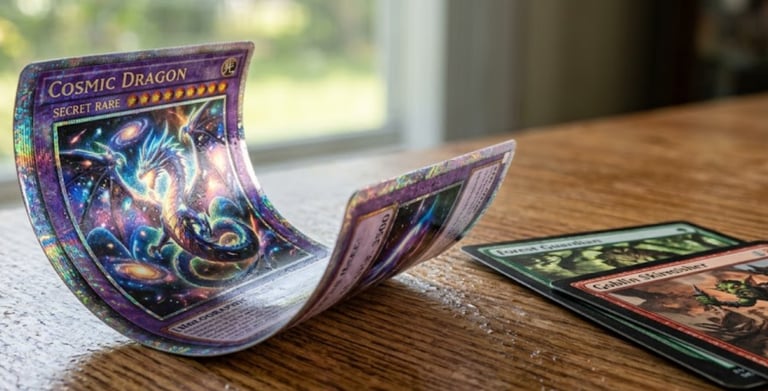
It's mid-June, and Kickstarter fulfillments are landing on doorsteps across Florida, Texas, and the East Coast. A player tears open a booster pack of your newly launched indie TCG, pulls the highly anticipated Secret Rare holographic card, sets it on the table, and goes to grab a sleeve.
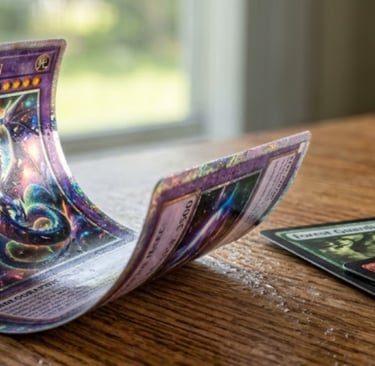
When they look back five minutes later, the card has curled up into the shape of a Pringle.
For an independent creator or a TCG studio, this is a brand-killer. Players view severely curled cards as "marked" (unplayable in tournaments) or inherently cheap. They will immediately take to Reddit and Discord to complain about your print quality, tanking your secondary market value before the game even gains traction.
As pre-press engineers, we field panicked emails from U.S. designers every summer asking why their factory failed them. The truth is, fighting humidity isn't about magic; it's a battle of structural physics and material science. Here is the exact data on why your cards are warping, and how VNK’s manufacturing floor engineers them to stay flat.
The Physics of the Curl: Asymmetric Surface Tension Explained
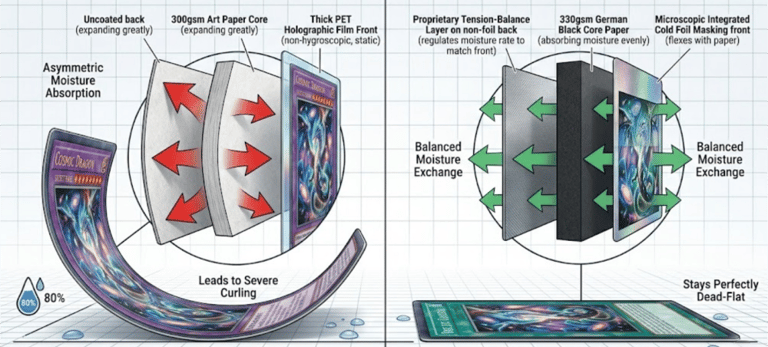
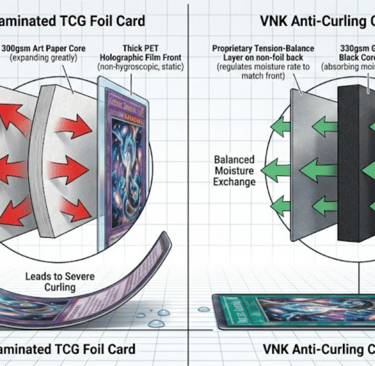
To fix the curl, you must understand the math behind it. A standard trading card features a hygroscopic core (paper) that naturally absorbs moisture from the air.
When a standard print shop makes a "foil" card, they typically apply a thick sheet of PET plastic holographic film over the front of the paper.
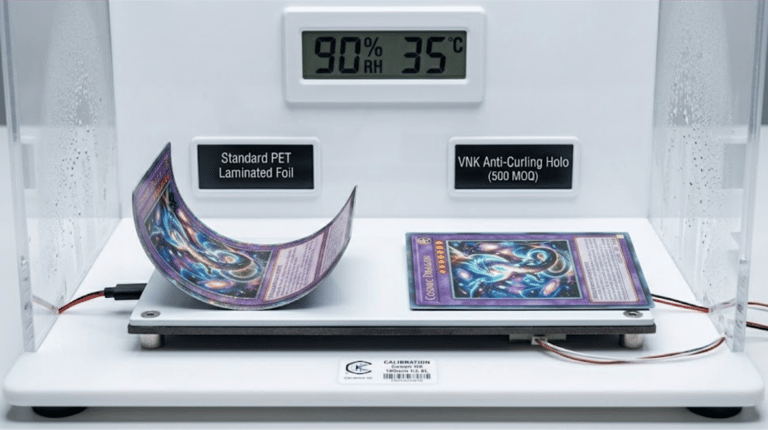
Because the paper back physically expands while the plastic layer remains static, the card bows inward, curling the edges up. If they move the card to a dry, air-conditioned room, the paper rapidly shrinks while the plastic stays the same, causing the card to curl in the opposite direction.
The VNK Engineering Solution: Anti-Curling Foil Technology
You cannot defeat thermodynamics with standard digital printers. Curing the "Pringle" effect requires heavy commercial offset machinery and highly specific material chemistry. At VNK, we attack the curling problem from two engineering vectors:
1. K=100 Cold Foil Masking
Instead of slapping a thick, rigid plastic sticker over your beautiful artwork, we utilize Cold Foil Masking on our Heidelberg presses. We lay down an ultra-thin, microscopic metallic base layer first, and then print your CMYK ink directly over it.
Because the cold foil layer is microscopically thin and integrated into the ink itself, it possesses almost zero structural rigidity. It flexes seamlessly with the paper. When the paper breathes, the foil breathes with it, drastically reducing the tension disparity between the front and the back.
2. Proprietary Tension-Balance Coating
To guarantee absolute flatness, we must match the physics of the front side with the back side. We apply a proprietary, invisible Tension-Balance Layer to the non-foil side of the cardstock.
This specialized varnish acts as an environmental buffer, regulating the rate at which the 330gsm German Black Core absorbs ambient moisture. By forcing both sides of the card to react to summer humidity at the exact same mathematical rate, the physical tension remains at zero. The card stays dead-flat.
TCG Creator FAQ: Summer 2026 Search Trends
Over the last 30 days, our data analytics tracked a massive spike in search queries from U.S. publishers trying to salvage their summer production runs. Here are the precise, data-driven answers to the top queries:
"Why do my custom MTG proxy/TCG foil cards curl immediately out of the pack?"
They curl due to asymmetric moisture absorption. If your current factory is using cheap PET lamination over standard 300gsm art paper without a moisture-buffering varnish, your cards are mathematically guaranteed to curl.
"Cold foil vs. hot stamping for trading cards: which curls less?"
Cold foil wins flawlessly. Hot stamping presses a solid, opaque foil block onto the card, creating heavy, rigid zones. Cold foil is applied in-line via offset printing, creating a flexible metallic layer that maintains structural equilibrium.
"How to fix the Pringling effect in foil cards after printing?"
Once printed with cheap materials, the damage is done. Heavy books or silica gel packets only offer temporary relief. The only permanent fix is preventative manufacturing using a tension-balance layer.
"Can I print anti-curling foil TCG cards at a low MOQ?"
Historically, Heidelberg cold foil required orders of 10,000+ booster packs. VNK has optimized our lines to support indie developers with a strict 500 MOQ. You get Tier-1 studio tech without bankrupting your launch budget.
Test the Physics Yourself
Don't launch your Kickstarter hoping the weather stays dry. You need to stress-test your materials before you collect your backers' money.
If you are a lead designer, an indie TCG publisher, or a procurement manager fighting against local kitting costs and terrible print quality, we want to prove our engineering. Take our K=100 cold foil samples, leave them on a desk in a non-air-conditioned room in the middle of a thunderstorm, and watch them stay flat. Let's engineer a flawless launch.
Add: Dongci Industrial estate, Shijie Town, Dongguan City, Guangdong Province, China 52300
Copyright 2025 © Dongguan VNK Playing Card Co., Ltd. All Rights Reserved.
CONTACT US
Email: info@vnkplayingcard.com
PRODUCTS
QUICK LINKS