

Grading-Ready TCG Printing: Securing a Gem Mint 10 Centering
To secure a Gem Mint 10 grade from authorities like GRAAD or PSA, a TCG manufacturer must strictly control two variables: Centering and Edge Quality.
BLOG
6/15/20264 min read
What manufacturing standards are required to achieve a Gem Mint 10 in TCG printing?
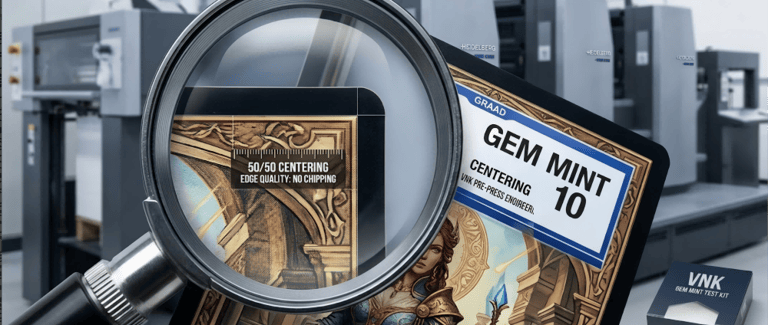
To secure a Gem Mint 10 grade from authorities like GRAAD or PSA, a TCG manufacturer must strictly control two variables: Centering and Edge Quality. This requires optical press alignment to guarantee a 50/50 centering with a cutting tolerance of ≤ 0.2mm. Furthermore, to prevent micro-chipping (whitening on the edges), factories must utilize frequently replaced high-carbon steel dies rather than standard commercial punching tools.
The GRAAD Reality Check: Art Doesn't Matter If the Cut Is Bad
The European indie TCG scene—especially in Italy—is currently in a golden era. You and your team have spent months balancing game mechanics, playtesting metas, and paying top-tier illustrators to design breathtaking Neo-Renaissance artwork.
But when your players finally tear open a booster pack, sleeve your rarest card, and send it off to GRAAD or PSA, they get hit with a heartbreaking reality: a "Near Mint 8."
The market has changed. Trading card games are no longer just tabletop experiences; they are highly scrutinized investment assets. Grading authorities do not care how beautiful your artwork is. Under a 10x magnifying loupe, graders are looking at cold, hard factory data: the millimeter ratio of your borders (centering) and the structural integrity of your paper fibers (edges).
If your current printing partner is churning out commercial playing cards or flyers, their machinery simply isn't calibrated for the brutal standards of the TCG grading world. Let's look at the actual physics of card manufacturing and how VNK engineers a "Grading-Ready" print run from the ground up.
The 0.2mm Truth: Why Your Cards Are Always Off-Center
You’ve seen it a hundred times: a card looks perfect on the front, but when you flip it over, the back border is wildly shifted to the left. Why does this happen?
Standard offset presses print 54 to 78 cards on a massive single sheet of paper. As that sheet moves through the heavy rollers at high speeds, it is subjected to immense pressure and moisture. Paper breathes, stretches, and shifts. If a factory's mechanical tolerance is hovering around 0.5mm to 1mm, that microscopic paper shift translates into a 60/40 or 70/30 off-center card. It is an instant death sentence for a Gem Mint grade.
Unlike standard mechanical guides, our heavy Heidelberg offset lines at VNK utilize real-time optical alignment. High-precision optical sensors track the registration crosshairs on every single sheet as it passes through the press. This allows us to lock the front-to-back registration and the final die-cutting tolerance to an absolute maximum of ≤ 0.2mm. When our machines punch your cards, you get that coveted 50/50 visual centering right out of the booster pack.
Micro-Chipping: The Invisible Enemy of Grading
Imagine opening a freshly printed, dark-bordered card, only to find microscopic white dots along the very edge. To a player, it’s annoying. To a GRAAD evaluator, it is classified as "edge wear" or "whitening," immediately dropping your grade.
This is called micro-chipping, and it is entirely the factory's fault.
Most budget print shops try to maximize their profit margins by extending the life of their punching dies. They will use the same metal die to punch hundreds of thousands of decks. Over time, that metal dulls. Instead of cleanly slicing through the heavy cardstock, a dull die crushes and tears the paper fibers, causing the edge ink to flake off.
We treat our die-cutting process with clinical precision. When printing high-density holographic substrates or our signature 330gsm German Black Core, we use specialized high-carbon steel dies. We strictly monitor their life cycles and swap them out well before they degrade. Every punch is surgical, leaving your cards with edges as smooth as cut glass.
The "Grading-Ready" Guarantee for Indie Studios
We know that indie developers do not have the cash flow to order 50,000 booster boxes just to access elite factory machinery. You are trying to launch a Kickstarter, test your game in local hobby shops, and build a community without going bankrupt.
That is why we integrated our optical alignment presses and automated algorithmic collation lines into a highly accessible 500 Booster Box MOQ.
You do not have to compromise on quality just because you are an independent studio. Our collation algorithms ensure your pull rates are mathematically flawless (no mapped boxes, no frustrating duplicate runs), while our cutting tolerances ensure every high-rarity card your players pull is physically capable of achieving a 10.
Put Us Under the Loupe: Claim Your Sample
Don't take our word for it. In this industry, the only thing that matters is what you see under the magnifying glass.
If you are a TCG developer or publisher preparing for a new set release, you need to test the physical goods. Send an email to our pre-press team. If your project is a good fit, we will ship you a VNK Gem Mint Test Kit.
Put our cards next to your current manufacturer's. Measure the borders. Inspect the edges under a loupe. Run them against your local GRAAD grading standards. The data will speak for itself.
Frequently Asked Questions (FAQ)
What is an acceptable centering ratio for a PSA or GRAAD 10?
For a perfect 10, the front of the card must typically fall within a 55/45 to 50/50 centering ratio, and the back must not exceed 75/25. VNK’s strict ≤ 0.2mm tolerance ensures your production run consistently hits these elite metrics, eliminating factory-caused centering defects.
Can bad cardstock cause frayed edges during cutting?
Absolutely. A low-quality, loosely woven paper core will tear and fray easily when punched, regardless of how sharp the die is. This is why VNK strictly uses tightly woven, premium 330gsm German Black Core or specialized high-density holographic substrates, pairing them with high-carbon steel dies to ensure razor-sharp, flawless edges.
Add: Dongci Industrial estate, Shijie Town, Dongguan City, Guangdong Province, China 52300
Copyright 2025 © Dongguan VNK Playing Card Co., Ltd. All Rights Reserved.
CONTACT US
Email: info@vnkplayingcard.com
PRODUCTS
QUICK LINKS