
Cold Foil vs. Hot Stamping: Visuals, Cost, and Gameplay Risks
Cold Foil vs. Hot Stamping: Don't let the wrong choice ruin your game mechanics. Compare costs, visuals, and shuffle feel in our expert TCG printing guide.
BLOG
1/9/20263 min read
Don’t Let the Wrong "Shine" Ruin Your Game
You’ve spent months designing your mechanics and artwork. Now, you want that "Wow" factor. You want your Super Rare cards to pop.
But here is the harsh truth: Choosing the wrong foil process doesn't just look bad—it can physically break your game mechanics.
At VNK, we see the same tragedy on repeat. A creator demands "Gold Hot Stamping" on a main deck card because they want it to look luxurious. The result? A deck that wobbles, stacks unevenly, and is technically "marked" for competitive play.
So, how do you choose? Do you go for the seamless magic of Cold Foil or the embossed luxury of Hot Stamping?
This guide strips away the factory jargon. We’re going to compare them based on the three things that actually matter to your backers: Visuals, Gameplay (Shuffle Feel), and Budget.
Round 1: The Visual Test (How It Looks)
The rookie mistake? Thinking "foil is foil." It isn't. They interact with your artwork in fundamentally different ways.
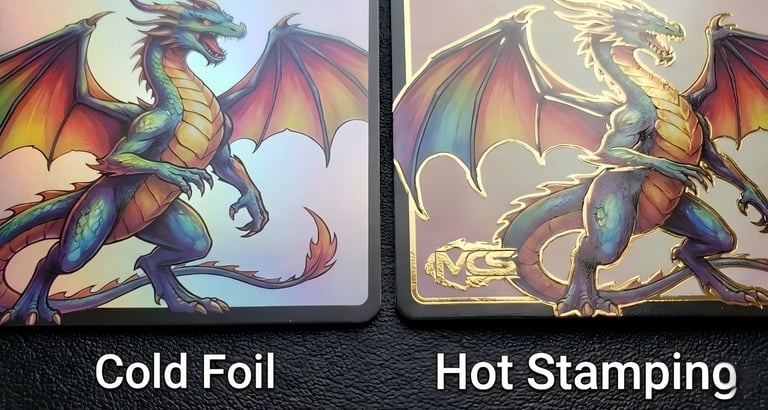
Cold Foil: The "Integration" Master
Think of Cold Foil as a metallic under-layer.
The Process: We apply a silver foil layer before printing your CMYK artwork.
The Effect: Because the ink sits on top of the foil, you can create metallic colors. Want a metallic blue dragon with metallic green eyes? Cold foil can do that in a single pass.
Precision: For complex art with fine lines that need to sparkle, Cold Foil offers surgical precision.
Hot Stamping: The "Pop" King
Think of Hot Stamping as molten metal pressed onto paper.
The Process: We use a heated metal die to stamp a pre-colored foil (Gold, Silver, Red, etc.) onto the finished card.
The Effect: It is incredibly shiny. It sits on top of your artwork and is completely opaque.
The Vibe: It screams "Premium." It reflects light with an aggressive, mirror-like intensity that cold foil can't match.
🏆 Winner for Full Art: Cold Foil 🏆 Winner for Logos/Borders: Hot Stamping
Round 2: The "Shuffle" Factor (The Dealbreaker)
Most factories gloss over this. But if you care about game mechanics, read this section twice.
The "Bump" Problem (Hot Stamping)
Hot Stamping uses heat and pressure. This inevitably leaves a physical impression on the card—a slight deboss (indentation) on the front and a potential bump on the back.
The Risk: In a 60-card deck, if 4 cards are Hot Stamped, seasoned players will feel the difference. You have accidentally created "marked cards." In a tournament setting, this is a disaster.
The Smooth Operator (Cold Foil)
Cold Foil is applied wet and dries completely flush with the paper surface.
The Result: A Cold Foil card feels exactly the same as a standard non-foil card. The thickness is uniform. The surface is smooth.
The Payoff: Players can mash-shuffle aggressively. No snagging. No peeling. No "judge calls" in tournaments.
🏆 Winner for Gameplay: Cold Foil (Hands down) 🏆 Winner for Packaging/Display: Hot Stamping
Round 3: The Budget (Where the Money Goes)
You’re running a Kickstarter. Every cent counts.
Hot Stamping Costs:
Hot stamping requires a physical Metal Die for every single unique design.
5 different Rare cards? 5 different molds. This gets expensive fast for small runs with many unique designs.
Cold Foil Costs:
Cold foil uses Printing Plates (just like standard printing).
Once the machine is set up, we can print 100 different foil card designs as easily as one.
The Rule of Thumb:
High volume, many different card designs? Cold Foil is cheaper.
Low volume, single design (like a card back or box logo)? Hot Stamping is cost-effective.
Bonus: The "Etched Foil" Alternative
Are you a Magic: The Gathering fan? You might be looking for that subtle, gritty sparkle known as Etched Foil.
This isn't traditional hot or cold foil. It’s a specialized combination of metallic varnish and texture layers. It doesn't scream like a mirror; it shimmers like stardust. It’s sophisticated, fingerprint-resistant, and currently trending huge in the TCG market.
At VNK, we have perfected the Etched Foil formula for creators who want their cards to look "mature" rather than just "shiny."
The Verdict: Which One Should You Choose?
Don't guess. Use this decision matrix:
Choose COLD FOIL if: ✅ You are printing playable cards for a TCG Main Deck. ✅ You need full-color metallic effects (gradients, rainbows). ✅ You have many different card designs in one set. ✅ You demand perfect shuffle performance.
Choose HOT STAMPING if: ✅ You are designing the Tuck Box packaging (Shelf appeal is key!). ✅ You are creating limited edition "Serial Numbered" cards that won't be played. ✅ You need a super-shiny Gold/Silver border or Logo.
Ready to Feel the Difference?
Reading about foil is one thing. Seeing the light hit the card edge is another. Don't finalize your specs until you've felt these cards in your own hands.
We’ve curated a specific VNK Sample Pack that includes:
A Cold Foil "Battle Card" (Smooth finish)
A Hot Stamped "Leader Card" (Tactile finish)
Our exclusive "Etched Foil" showcase
[Get Your Free Sample Pack Here] and stop guessing with your manufacturing. Let’s build a legendary deck together.
Add: Dongci Industrial estate, Shijie Town, Dongguan City, Guangdong Province, China 52300
Copyright 2025 © Dongguan VNK Playing Card Co., Ltd. All Rights Reserved.
CONTACT US
Email: info@vnkplayingcard.com
PRODUCTS
QUICK LINKS